Instagram Reels Algorithm 2026: Complete Guide
Instagram Reels algorithm changed in 2026. Learn the 3 major updates, 5 ranking factors, and 2-stage distribution system. Optimize for 5-10x more reach.
Your Instagram Reels views tanked in early 2026? You're not alone. Instagram rolled out three major algorithm updates between December 2025 and April 2026 that fundamentally changed how Reels get distributed.
The stakes are high: Reels now account for 46% of all time spent on Instagram in the US (up from 37% in 2024), according to CNBC's analysis of Sensor Tower data. With 140 billion daily Reels plays across nearly 2 billion users, understanding the algorithm isn't optional—it's essential.
The good news? Instagram has been more transparent than ever about how the algorithm works. In this guide, I'll break down exactly what changed, which ranking factors matter most, and how to optimize your Reels for maximum reach in 2026.
What Changed in the Instagram Reels Algorithm (2026 Updates)
Update 1: "Your Algorithm" Feature (December 2025)
Instagram launched a feature that lets users actively control what they see in Reels and Explore. Users can now:
- Review topics Instagram thinks they care about
- Add new topics they want to see more of
- Down-rank topics they don't want to see
What this means for creators: Your Reels need to match the topics your audience actively chooses, not just what Instagram predicts. If there's a mismatch, your content won't surface even if it's well-made.
What this means: you need clearer content positioning and consistent topic focus. No more posting random topics and hoping the algorithm figures it out.
Update 2: Originality Score Expansion (April 2026)
Instagram got serious about original content in April 2026. The "Aggregator Penalty" that used to only hit Reels? Now it applies to everything—photos, carousels, the works.
Accounts that primarily repost others' content will no longer be recommended.
The numbers are striking: 75% of recommendations in the US now come from original posts, according to MediaPost's May 2026 analysis of Instagram's algorithm update.
What counts as original:
- Photography and edits that reflect your creative vision
- Third-party content with substantial edits that add new information
- Using Instagram's Remix feature to transform the original
What gets penalized:
- Reposting TikTok videos with watermarks
- Simple screenshot reposts
- Aggregating others' content without meaningful transformation
Update 3: Follower-First Distribution (March 2026)
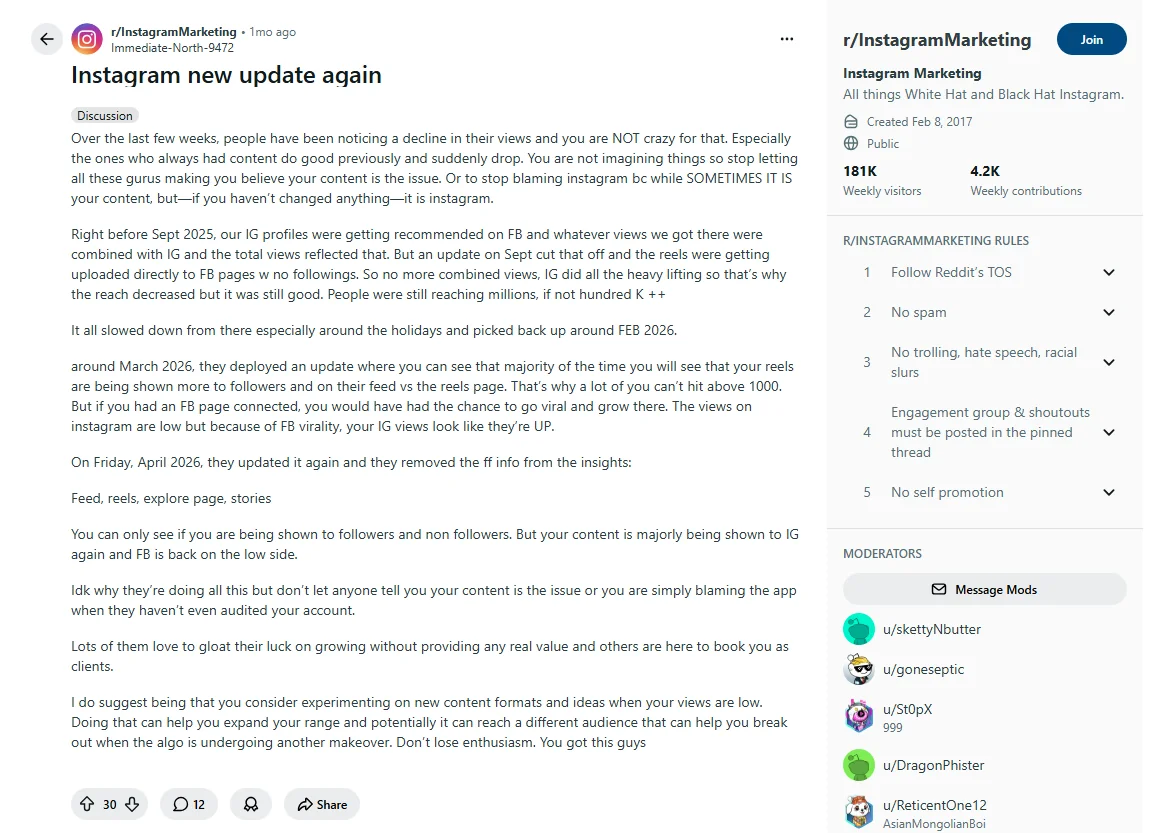
A Reddit user in r/InstagramMarketing noticed a significant shift:
"Around March 2026, they deployed an update where you can see that majority of the time your reels are being shown more to followers and on their feed vs the reels page. That's why a lot of you can't hit above 1000."
Instagram now uses a two-stage distribution system:
- Stage 1: Test your Reel with followers and a small group of similar-interest users
- Stage 2: If performance is strong, push to Explore and Reels tab
This explains why many creators struggle to break 1,000 views—their Reels aren't passing the follower test to reach Stage 2.
How the Instagram Reels Algorithm Works in 2026
Instagram head Adam Mosseri has been increasingly transparent about ranking factors. Here's what actually matters, ranked by importance.
Ranking Factor 1: Sends & Shares (Highest Weight)
The number of times your Reel is sent via DM is the strongest ranking signal.
Instagram head Adam Mosseri explained in a January 2026 conversation with YouTubers Colin and Samir:
"Short-form video is so symbiotic with connecting people with their friends. Part of our reason to be is to connect people with friends."
How to optimize: Create content people want to share with specific friends. Think relatable moments, useful tips, or funny observations that spark conversations.
Ranking Factor 2: Retention & Watch Time (Highest Weight)
Here's where it gets interesting. Instagram doesn't just look at completion rate—it weighs relative retention.
Here's the thing: a 10-second Reel with 5 seconds watch time (50% completion) loses to a 90-second Reel with 30 seconds watch time (33% completion).
Why? Because holding someone for 30 seconds is way harder than 5 seconds. The algorithm gets this.
Completion rate benchmarks by length (from Digital Applied's comprehensive analysis of 180+ Instagram statistics in 2026):
| Video Length | Average Completion Rate |
|---|---|
| 15-30 seconds | 72% |
| 30-60 seconds | 46% |
| 60-90 seconds | 28% |
| 90+ seconds | <20% |
How to optimize:
- Hook viewers in the first 3 seconds (according to Teleprompter's 2025 Reels analysis, Reels with 60%+ 3-second hold rate achieve 5-10x more reach than those below this threshold)
- Keep most Reels between 30-90 seconds for the best balance
- Design loops so viewers watch multiple times
- Track average watch time, not just completion rate
Ranking Factor 3: Audio & Visual Matching (High Weight)
Instagram's algorithm is hunting for watermarks and reposted content. Get caught, and your reach tanks. The "Aggregator Penalty" significantly reduces reach for:
- TikTok videos with watermarks
- Reposted content without transformation
- Low-effort aggregation
How to optimize:
- Create original content or re-record TikToks natively in Instagram
- Use trending or original audio
- Add unique text overlays, graphics, or creative edits
Ranking Factor 4: User Relationships (Medium-High Weight)
Instagram looks at your previous interactions with an account. If someone frequently engages with your content, they're more likely to see your new Reels.
This ties into the two-stage distribution: your followers see your Reel first. If they engage, Instagram pushes it to non-followers.
How to optimize:
- Reply to comments to build relationships
- Use Stories to stay top-of-mind between Reels
- Encourage saves and shares (stronger signals than likes)
Ranking Factor 5: Account Authority (Medium Weight)
Established accounts with consistent engagement patterns get an algorithmic advantage. Instagram rewards:
- Consistent posting frequency (3-5 Reels per week is the sweet spot)
- Original content history
- No violations or spam behavior
Understanding the Two-Stage Distribution System
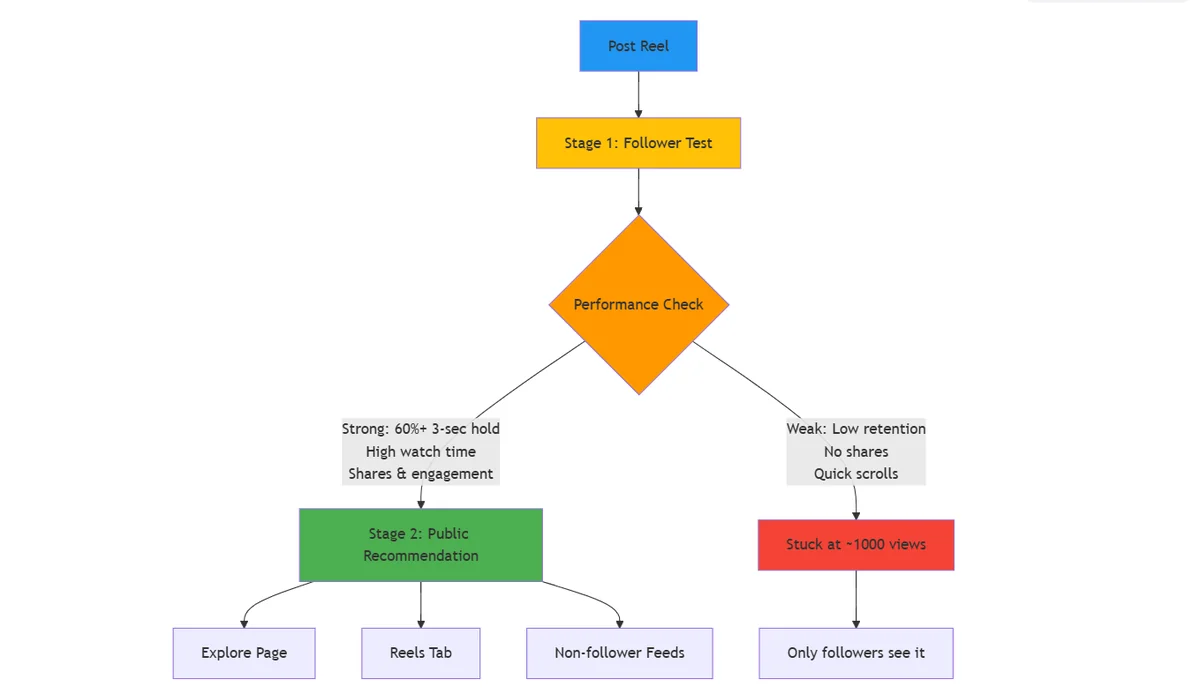
This is the key to breaking through the 1,000-view ceiling many creators hit in 2026.
Stage 1: Follower Test (First 1-3 Hours)
Instagram shows your Reel to:
- Your followers
- A small group of users who engage with similar content
Instagram watches four things:
- Do people stick around past 3 seconds?
- How long do they actually watch?
- Are they sending it to friends?
- Are they engaging (likes, comments, saves)?
Stage 2: Public Recommendation (If Stage 1 Performs Well)
If your Reel passes the follower test, Instagram pushes it to:
- Explore page
- Reels tab
- Recommended content for non-followers
The data: According to Loopex Digital's 2026 Instagram Reels Statistics report analyzing engagement patterns across thousands of accounts, 55% of Reels views come from non-followers on average. If you're not hitting that, your Reels aren't reaching Stage 2.
How to track this: Use EagleReels to monitor your follower vs. non-follower view ratio. If you're stuck at 80%+ follower views, you need to optimize for Stage 1 performance.
Why Your Reels Might Be Stuck at Low Views
Based on the March 2026 update, here are the most common reasons:
Problem 1: Weak First 3 Seconds
If viewers scroll away immediately, your Reel won't pass the follower test.
Solution: Your first frame needs to stop the scroll. Try:
- Pattern interrupts ("Wait, what?")
- Shocking visuals (something unexpected)
- Immediate value ("Here's how to...")
Test 5 different hooks, then double down on what hits 60%+ 3-second hold rate.
Problem 2: Wrong Video Length
The data's clear: 15-30 second Reels get 72% completion. Stretch to 60-90 seconds? That drops to 28%.
Solution: Match length to content type:
- Quick tips: 15-30 seconds
- Tutorials: 30-60 seconds
- Stories/case studies: 60-90 seconds
- Avoid 90+ seconds unless you have exceptional content
Problem 3: Low Shareability
If people aren't sending your Reel to friends, it won't get algorithmic boost.
Solution: Create content that solves specific problems, makes people laugh, or sparks "you need to see this" reactions.
Problem 4: Reposted Content
The April 2026 Originality Score update penalizes aggregated content.
Solution: Create original content or add substantial transformation to third-party content.
Optimal Posting Strategy for 2026
Based on TrueFuture Media's comprehensive Instagram Reels Reach 2026 guide, which analyzed performance data from New Jersey businesses across multiple industries, here's what works:
Posting Frequency
Sweet spot: 3-5 Reels per week
Here's the truth: more posts ≠ more reach. The algorithm cares about watch time, not how often you post. Pump out 10+ Reels a week? You'll burn out before you see results.
Best Posting Times
According to Loopex Digital:
- 7-9 AM (local audience time zone)
- 11 AM-1 PM (local audience time zone)
Important: 41% of total Reel views come within the first 24 hours. Timing matters for that initial follower test.
Content Mix
Don't just post Reels. Instagram's algorithm favors accounts that use multiple formats:
- Reels (3-5 per week)
- Stories (daily)
- Carousels (1-2 per week)
This signals you're an active, engaged creator rather than a one-format account.
How to Track What's Working
Instagram pulled the detailed breakdown (Feed/Reels/Explore) in April 2026. Now you get two numbers: follower views and non-follower views. That's it.
Key metrics to track:
- Average watch time (more important than completion rate)
- Follower vs. non-follower view ratio (target 45%+ non-follower)
- Sends per reach (strongest ranking signal)
- 3-second hold rate (target 60%+)
- Saves per reach (indicates valuable content)
Using EagleReels: Track these metrics over time to identify which Reels break through to Stage 2 distribution. Look for patterns in:
- Hook styles that achieve high 3-second hold rates
- Video lengths that maximize watch time
- Topics that generate the most shares
- Content that attracts non-follower views
Common Myths About the 2026 Algorithm
Myth 1: "Hashtags Don't Matter Anymore"
Reality: Hashtags are filing labels now, not growth hacks. They help Instagram categorize your content, but they won't magically boost your reach.
Recent studies cited by TrueFuture Media show posts without hashtags achieved 23% higher reach than hashtag-heavy posts.
Myth 2: "Longer Reels Get Penalized"
Reality: Instagram now recommends longer Reels (60-90 seconds) in Explore if they maintain strong retention. Sprout Social's 2025 Content Benchmarks Report, which analyzed millions of posts across thousands of accounts, shows Reels already achieve a 2.46% engagement rate, and longer storytelling is being rewarded.
Myth 3: "You Need to Post Daily to Grow"
Reality: Consistency matters more than frequency. 3-5 quality Reels per week outperform 10+ mediocre ones. The algorithm rewards watch time and engagement, not just volume.
Conclusion: Adapting to the 2026 Algorithm
Bottom line: the 2026 algorithm doesn't care how often you post. It cares about five things:
- Gets shared (strongest ranking signal)
- Holds attention (watch time > completion rate)
- Is original (no watermarks or simple reposts)
- Passes the follower test (strong first 3 seconds)
- Matches user-selected topics ("Your Algorithm" feature)
The two-stage distribution system means you need to optimize for your existing audience first. If your followers engage, Instagram will push your content to non-followers.
Track your follower vs. non-follower view ratio using tools like EagleReels. If you're stuck at 80%+ follower views, focus on improving your Stage 1 performance: stronger hooks, better watch time, and more shareable content.
The algorithm will keep changing. But the core stays the same: make stuff people actually want to watch and share.
Start there. Everything else is just tweaking.
Want to track your Reels performance? Try EagleReels to monitor follower vs. non-follower views, average watch time, and identify which Reels break through to Stage 2 distribution.
Frequently Asked Questions
Q: How long should my Reels be in 2026? A: Aim for 30-90 seconds. Short Reels (15-30s) get watched all the way through (72% completion), but longer ones (60-90s) rack up more total watch time—if you can keep people hooked.
Q: Why are my Reels only showing to followers? A: Instagram's March 2026 update prioritizes follower distribution first. If your Reel doesn't perform well with followers (weak hook, low watch time, no shares), it won't reach Stage 2 (non-followers).
Q: Do hashtags still work? A: Hashtags help categorize content but don't significantly boost reach. Use 3-5 relevant hashtags, but focus on watch time and shareability instead.
Q: Should I repost my TikTok videos? A: Don't. Instagram's Originality Score will kill your reach if you cross-post TikToks with watermarks. Re-record in Instagram, or at minimum, remove the watermark and add your own spin.
Q: How often should I post Reels? A: 3-5 Reels per week is optimal. Quality and watch time matter more than posting frequency.
Q: What's the most important ranking factor? A: Sends and shares (via DM) are the strongest signal, followed by watch time/retention.
Ready to track your Instagram Reels performance?
Download EagleReels Chrome extension and start analyzing your Reels today. It's free!
Download EagleReelsRelated Articles

Data-Driven Instagram Reels Content Strategy (Competitor Data)
Build a data-driven Instagram Reels content strategy using competitor data—tracking workflows, growth signals, test calendars, and tools that beat guesswork.

Instagram Reels Analytics for Agencies: Lightweight Competitor Workflow
Instagram Reels analytics for agencies—a lightweight competitor workflow with CSV exports, client benchmarks, free tools, and no heavy SaaS stack.

Best Chrome Extensions for Instagram Reels Analytics in 2026
Compare the best Chrome extensions for Instagram Reels analytics in 2026—sorting, growth rate, exports, privacy, and which extension fits creators vs. agencies.